Harpsichordist · Pianist · Conductor · Organist · Music Educator
Online artistic tutoring
Sometimes another lesson is not what is needed. What is needed is the right perspective.
Individual music consultations for instrumentalists and students who already play, but want to overcome their own limitations, understand the music they perform more deeply and take the stage with greater awareness.
Edyta Środa’s artistic tutoring is not tuition in playing an instrument from the beginning. It is an encounter between two musical perspectives: that of a person who brings a specific repertoire, question or difficulty, and that of an experienced artist and music educator who can hear the cause of the problem, name it and propose a practical path for further work.
This perspective grows out of Edyta’s own path — from her studies and masterclasses to the stage, recordings, ensemble work and many years of teaching. It therefore allows a problem to be considered simultaneously in terms of gesture, sound, style, the construction of a phrase and the dramaturgy of the performance as a whole.
music mentoringone-to-one masterclassinterpretation workshopstage laboratoryperformance consultation
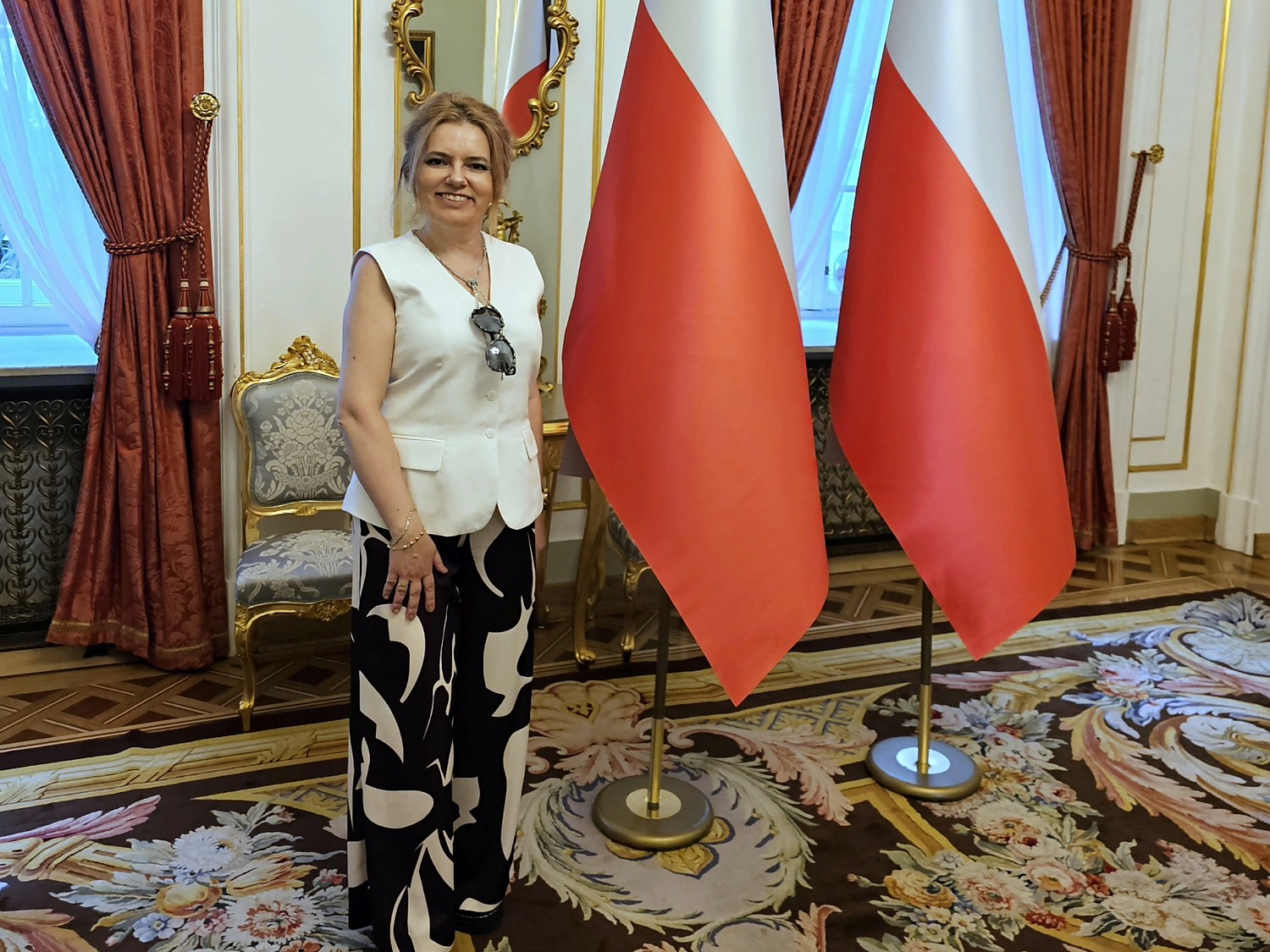
Edyta Środa at the Belweder Palace · 2025 · photograph from Edyta’s archive
Individual session
60 minutes online from EUR 60
One person, one specific aim and a full hour devoted to music.
The price is stated from the outset so that there is no uncertainty before making contact. The session takes place online, one to one with Edyta. After a brief assessment of the musician’s needs, the subject of the consultation and the material worth working on are agreed.
It is a form of individual work intended for people who already possess instrumental technique and need precise, expert feedback. It may take the form of an online music consultation, a private masterclass, a recording analysis, an interpretation workshop or a kind of stage laboratory. The point of departure is always the musician’s real situation — a specific work, examination, concert, work as an organist, technical problem or the feeling that, despite many hours of practice, a performance is not developing in the desired direction.
Edyta does not impose one school or one set of prescriptions. First she listens: to sound, phrase, pulse, articulation, the relationship between voices, formal tension and the way in which the performer thinks about the work. She then helps distinguish a symptom from its cause. Unevenness may result not only from insufficient technique, but also from an incorrect gesture, an unclear phrase plan, an inappropriate practice tempo or a lack of hierarchy in the score.
The aim is not temporarily to “correct a piece” under a teacher’s supervision. The aim is to equip the musician with methods that enable them, after the session, to work more effectively on their own, make conscious interpretative decisions and prepare a performance that has its own logic and a convincing stage presence.
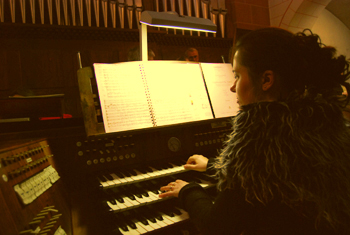
Organ, piano and harpsichord — different instruments, shared questions of phrase, time and expression
Who is it for?
For musicians who want to take the next conscious step
What matters is not age or formal status, but previous experience and a readiness to work on a specific issue.
01
Students before an examination
Preparation of an examination programme, audition, graduation recital or competition programme. Work on the performance as a whole, resilience under pressure and the moments that most often lose stability during a public performance.
02
Organists
Consultations for those who play in liturgies and concerts and wish to develop their shaping of phrase, choice of registrations, articulation, voice leading, organisation of work and the musical quality of their accompaniment.
03
Harpsichordists
Work on musical rhetoric, ornamentation, articulation, agogics, national style, the realisation of basso continuo, choice of registers and the construction of a narrative without the dynamic means available to the piano.
04
Pianists
Consultation on interpretation, voice leading, pedalling, proportions of sound, the construction of climaxes, memory work and ways of drawing a clear architecture of the work from the score.
05
Musicians returning to playing
Help with rebuilding regular practice, choosing repertoire, regaining confidence and developing a method of work after a longer break — without being treated like a child and without returning to schoolroom patterns.
06
Performers looking for an impulse
For people who perform a work correctly but feel that it lacks direction, character or personal expression. Tutoring helps find the questions that lead to a more convincing interpretation.
Stage laboratory
From score to presence before an audience
An examination or concert performance does not begin with the first note. It is made up of decisions taken earlier: the method of preparation, the order of work, the distribution of energy, the response to a mistake and the ability to regain concentration.
Performance audit
Edyta listens to a work or to a recording sent in advance and identifies the principal areas in which change can have the greatest effect: from technique and the organisation of movement to phrase, tempo, narrative and style.
One-to-one masterclass
Intensive work on a selected work or section of a programme. Instead of general remarks, there are specific trials, comparisons of alternatives and an immediate examination of how a given decision affects the sound.
Mock examination
A simulated uninterrupted performance followed by a discussion of the programme’s dramaturgy, concentration, the opening of the first work, transitions between movements and the response to an unexpected slip.
Plan for further work
The session ends with the establishment of priorities: what to practise, in what order, how to monitor progress and what not to repeat mechanically. The musician receives direction, not dependence on further sessions.
Examples of online sessions
A great deal can be achieved with a specific question in a single hour
The situations below illustrate possible ways in which a consultation may unfold. Every session, however, is planned individually around the person, the repertoire and the aim.
Organist
“I play during Mass, but my accompaniments sound alike”
Analysis of a short recording, a conversation about the function of music in the liturgy, the shaping of melody, harmonisation, registration and the building of a different character for successive parts. The outcome may be a set of practical exercises and new ways of preparing material for forthcoming services.
Piano student
“The programme is prepared, but I lose confidence in the examination”
A trial performance under conditions resembling an examination, identification of the points at which tension affects breathing, tempo or memory, and development of a strategy for entering the stage. We work both on the music and on recovering the narrative flow after a minor mistake.
Harpsichordist
“All the notes are in place, but the piece does not speak”
An interpretation workshop devoted to the hierarchy of voices, articulation, ornamentation, rhetoric and the differentiation of time. Comparing several possible solutions helps the performer hear which of them arises from the style and construction of the work, and which remains merely impressive.
Pianist returning after a break
“I practise for a long time, but I do not know whether I am practising effectively”
An assessment of the method of work, division of the material into realistic stages, separation of technical from musical problems and the establishment of measurable aims. A single consultation can become the beginning of an independent programme for returning to form.
Experience passed on
Five diplomas, international masterclasses and stage experience
The foundation of the tutoring is Edyta’s comprehensive education in Kraków and Karlsruhe, encompassing instrumental performance, music education, ensemble conducting and the highest stage of solo harpsichord training. Five diplomas are not a decorative number here — they represent experience of passing through different systems of work, examination requirements and ways of thinking about music.
Equally important is her contact with outstanding representatives of historical performance. Edyta took part in international academies, seminars and masterclasses, working on the harpsichord, basso continuo, period performance practice, and solo, chamber and orchestral repertoire. She experienced both the precision of individual work and responsibility for her own part within a larger structure.
To this can be added years of concerts, recordings, work as an accompanist, conductor and music educator. A consultation can therefore address not only what is audible at a given moment, but also the entire process leading to a performance: the choice of means, the organisation of rehearsals, collaboration with other musicians and the psychology of the stage.
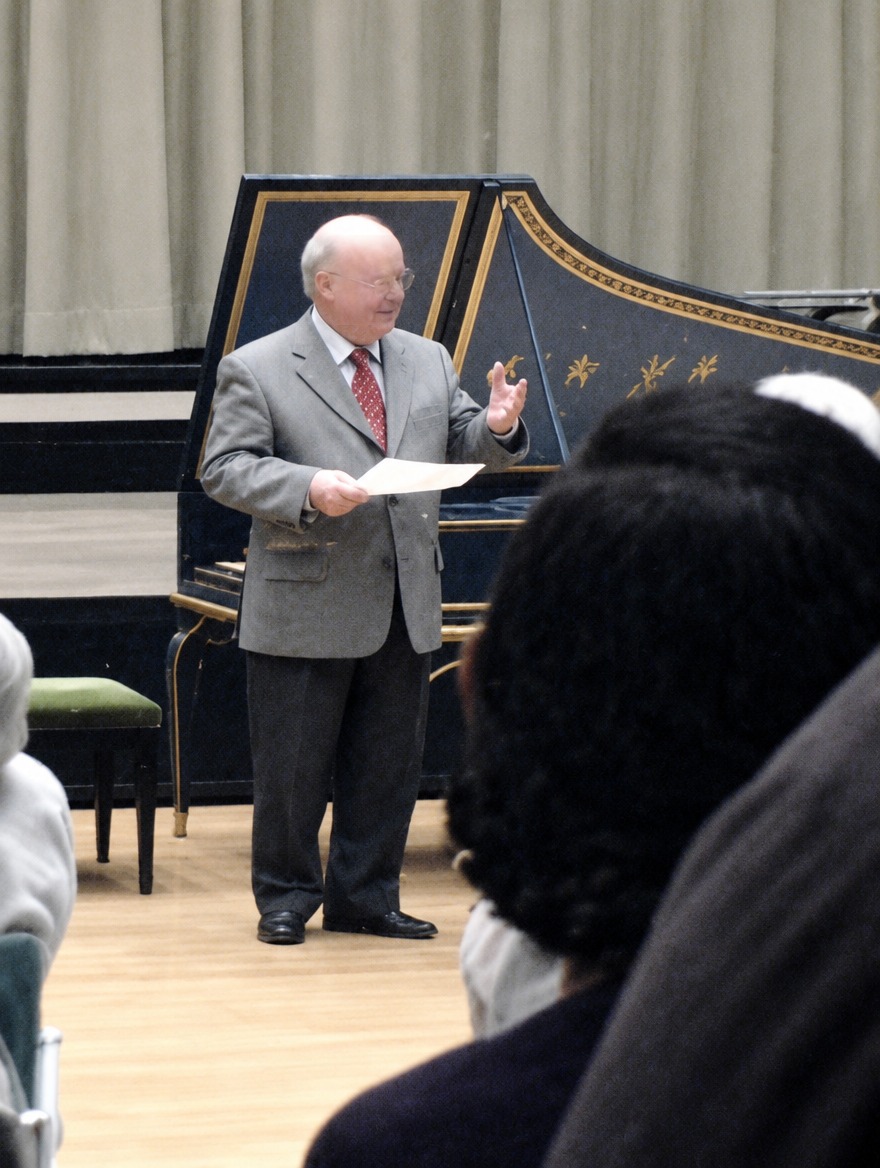
Kenneth Gilbert during a session devoted to the harpsichord · Edyta’s archive
Selected academies and masterclasses
Tradition lives when it passes from one experience to another
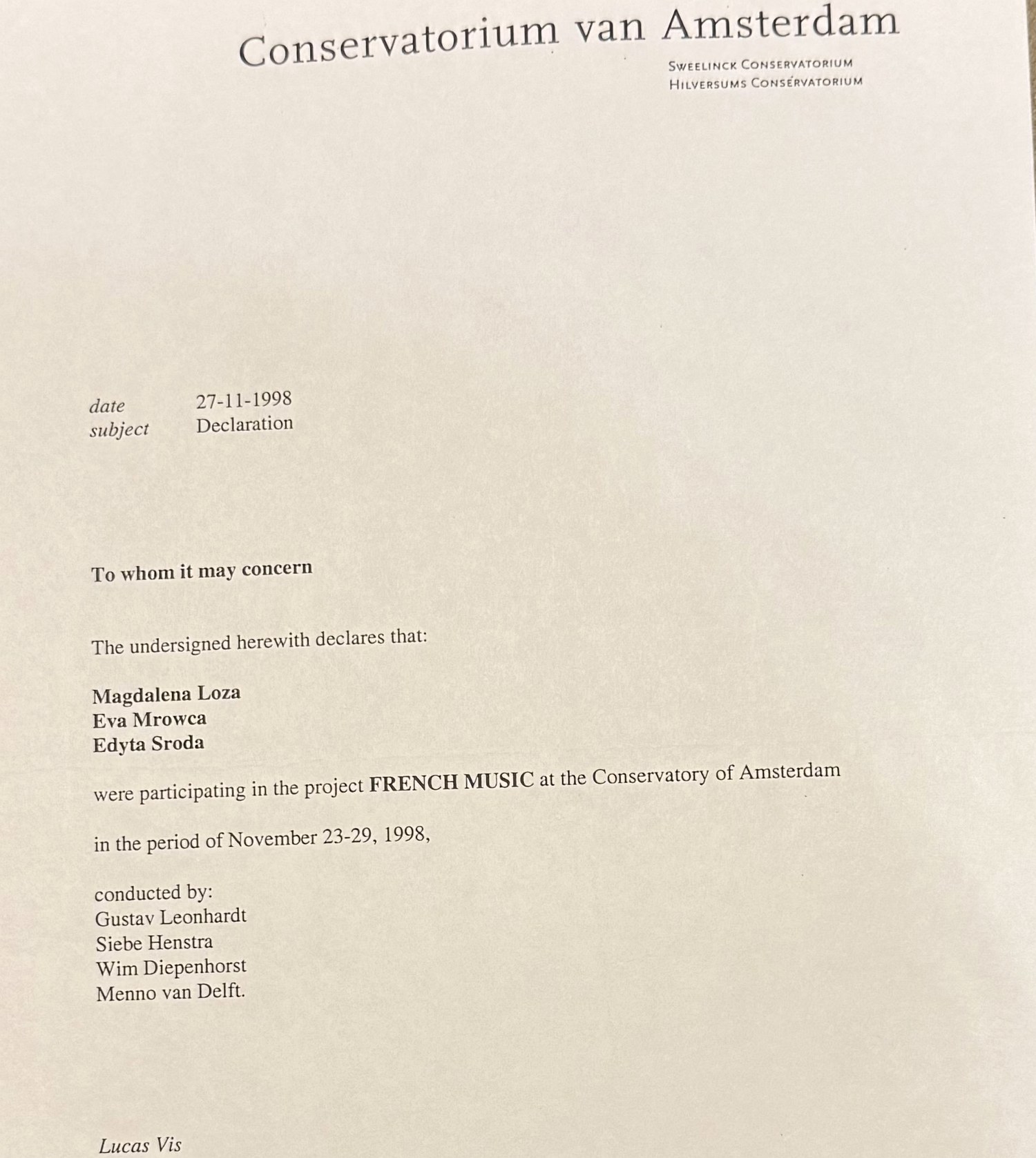
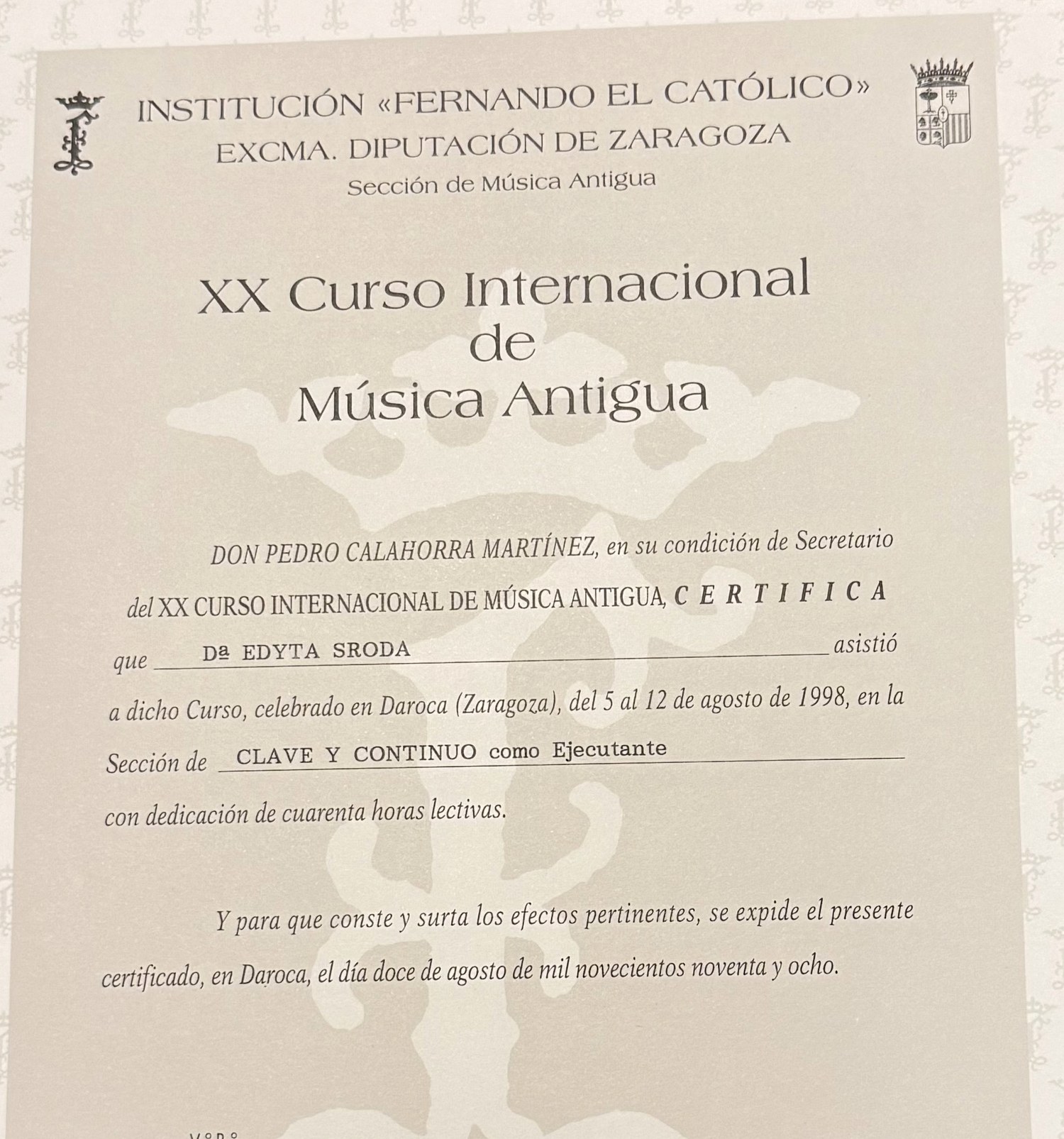
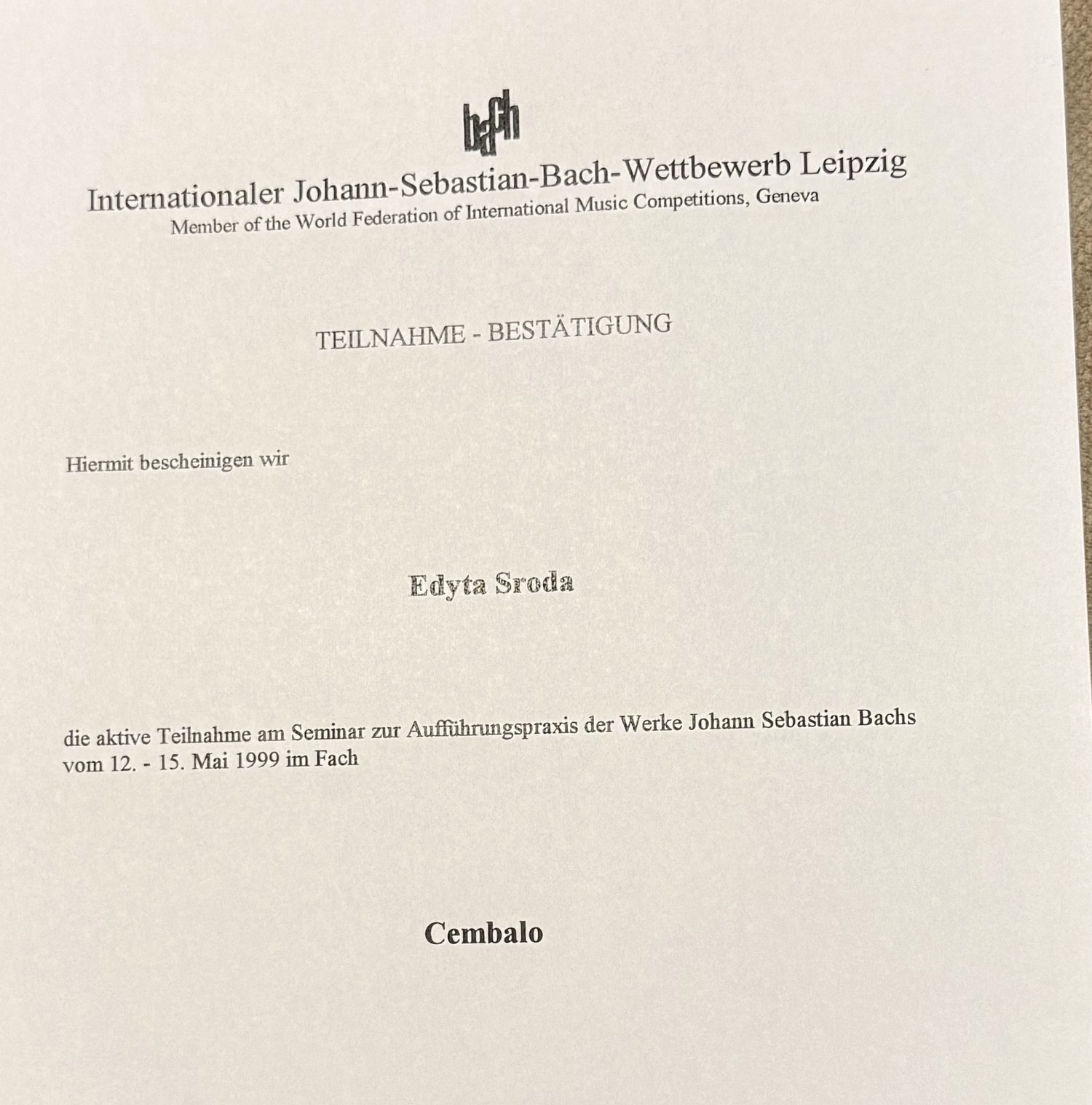
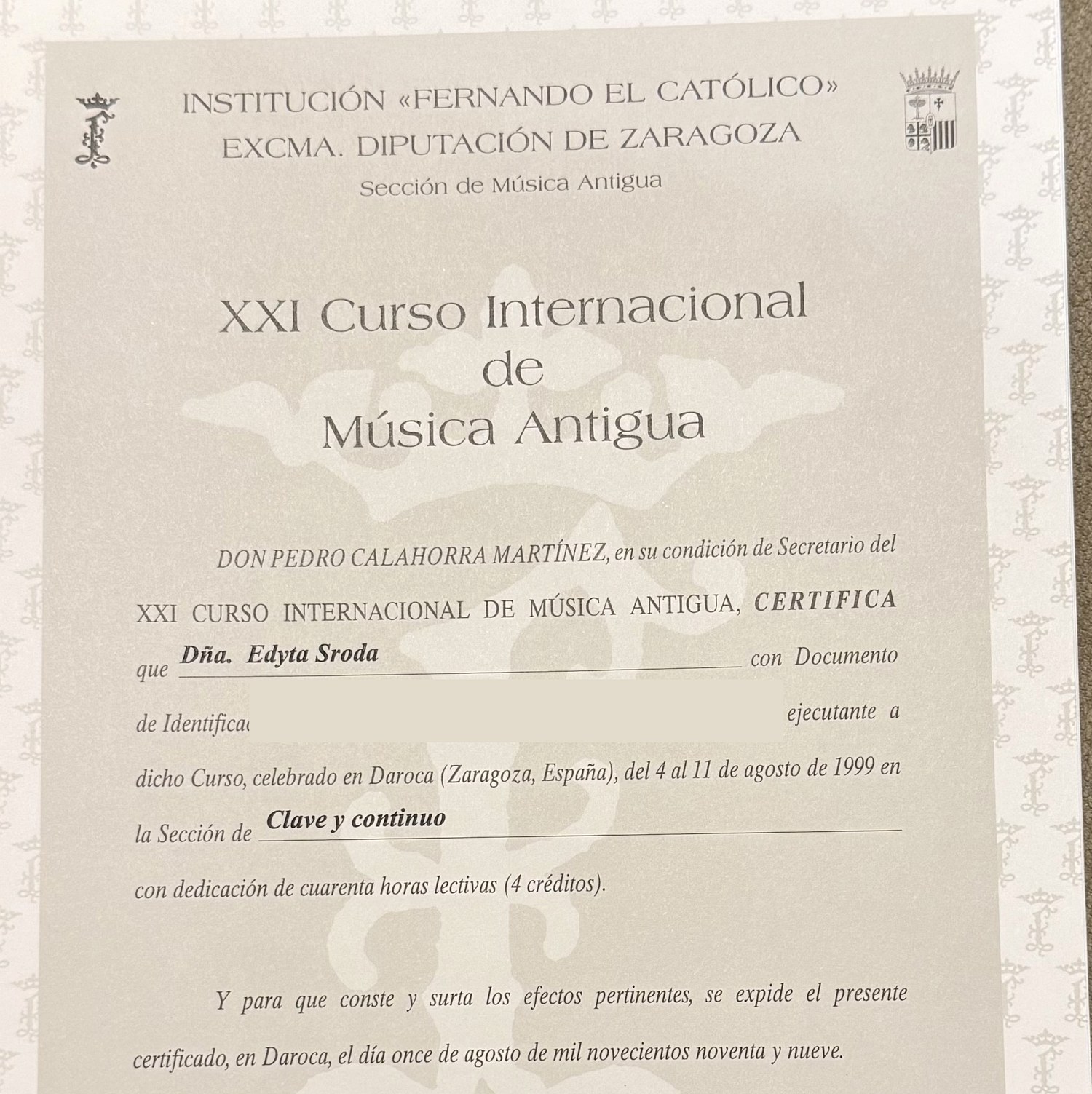
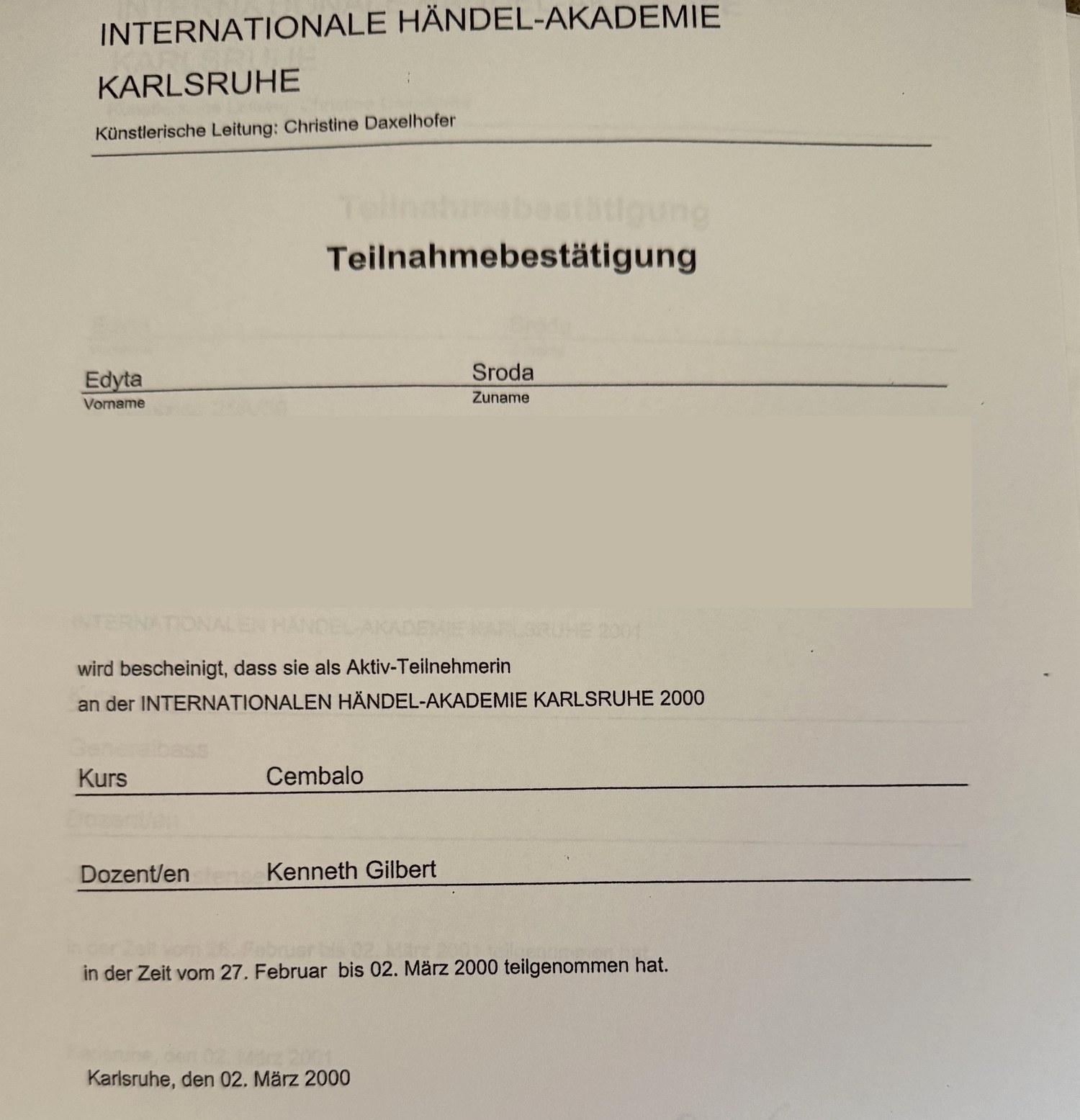
Edyta’s archive documents an intensive period of active work with teachers and performers who helped shape the modern understanding of early music. Ten surviving documents are presented below — each can be opened at a larger size.
Copies prepared for publication: the photographic background, old address details, document numbers and handwritten signatures have been removed or permanently obscured.
An active project led by Gustav Leonhardt, Siebe Henstra, Wim Diepenhorst and Menno van Delft. The encounter with several performing personalities made it possible to observe French repertoire from the perspectives of the harpsichord, organ, chamber music and ensemble practice.
Edyta’s first documented participation as a performer in the clave y continuo section: the course took place from 5 to 12 August and comprised forty hours of classes.
Active participation in a seminar on the performance practice of Johann Sebastian Bach’s works in the harpsichord class led by Andreas Staier, from 12 to 15 May 1999.
The second documented course, from 4 to 11 August: forty hours of active work with Yves Rechsteiner and Christine Whiffen. The certificate records participation as a performer, not passive attendance.
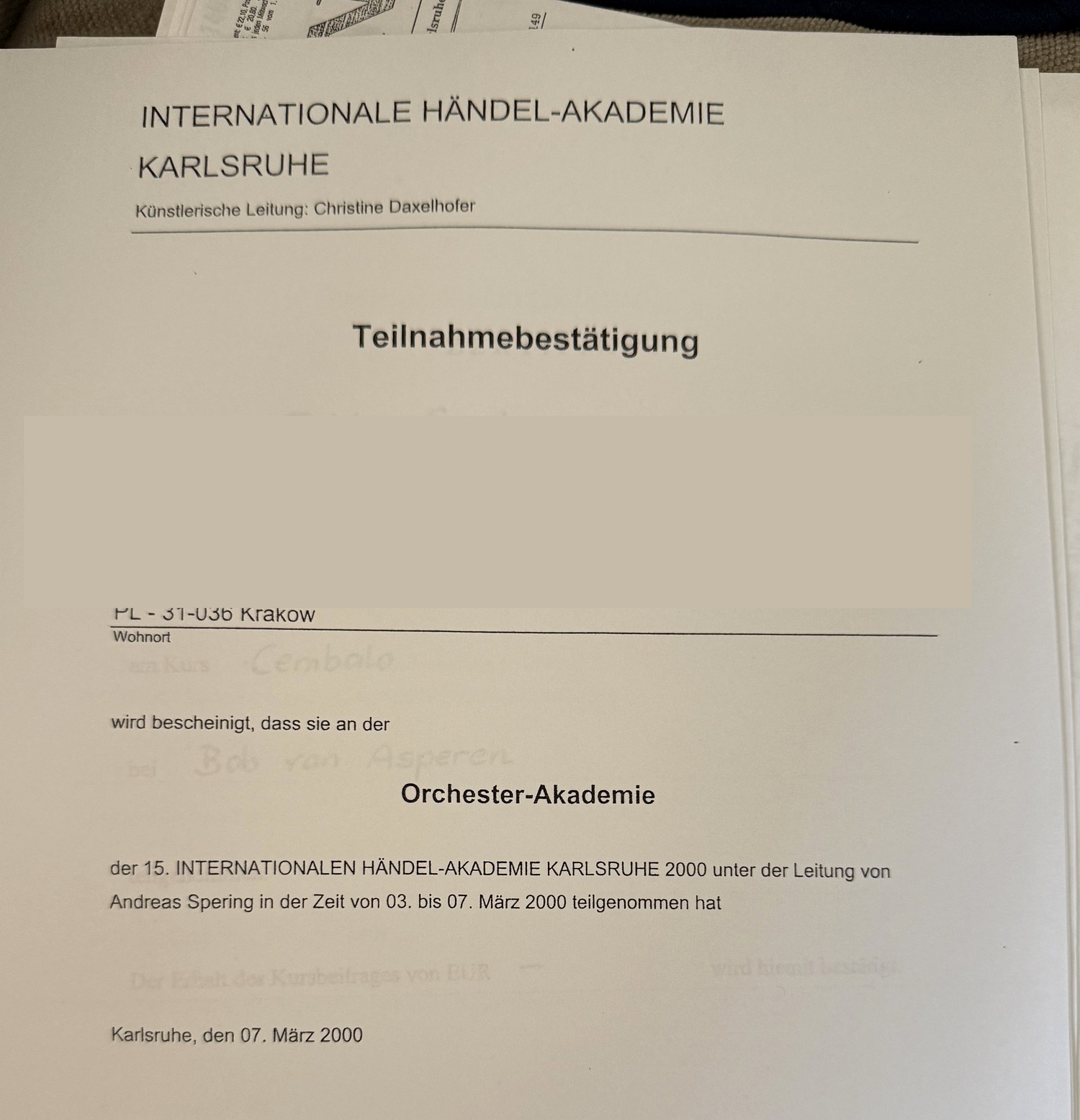
A harpsichord course led by Kenneth Gilbert from 27 February to 2 March, followed by the Orchester-Akademie conducted by Andreas Spering from 3 to 7 March. Individual work on repertoire was directly combined here with responsibility for one’s part in a larger ensemble.
2001
Figured bass and the Orchester-Akademie in Karlsruhe
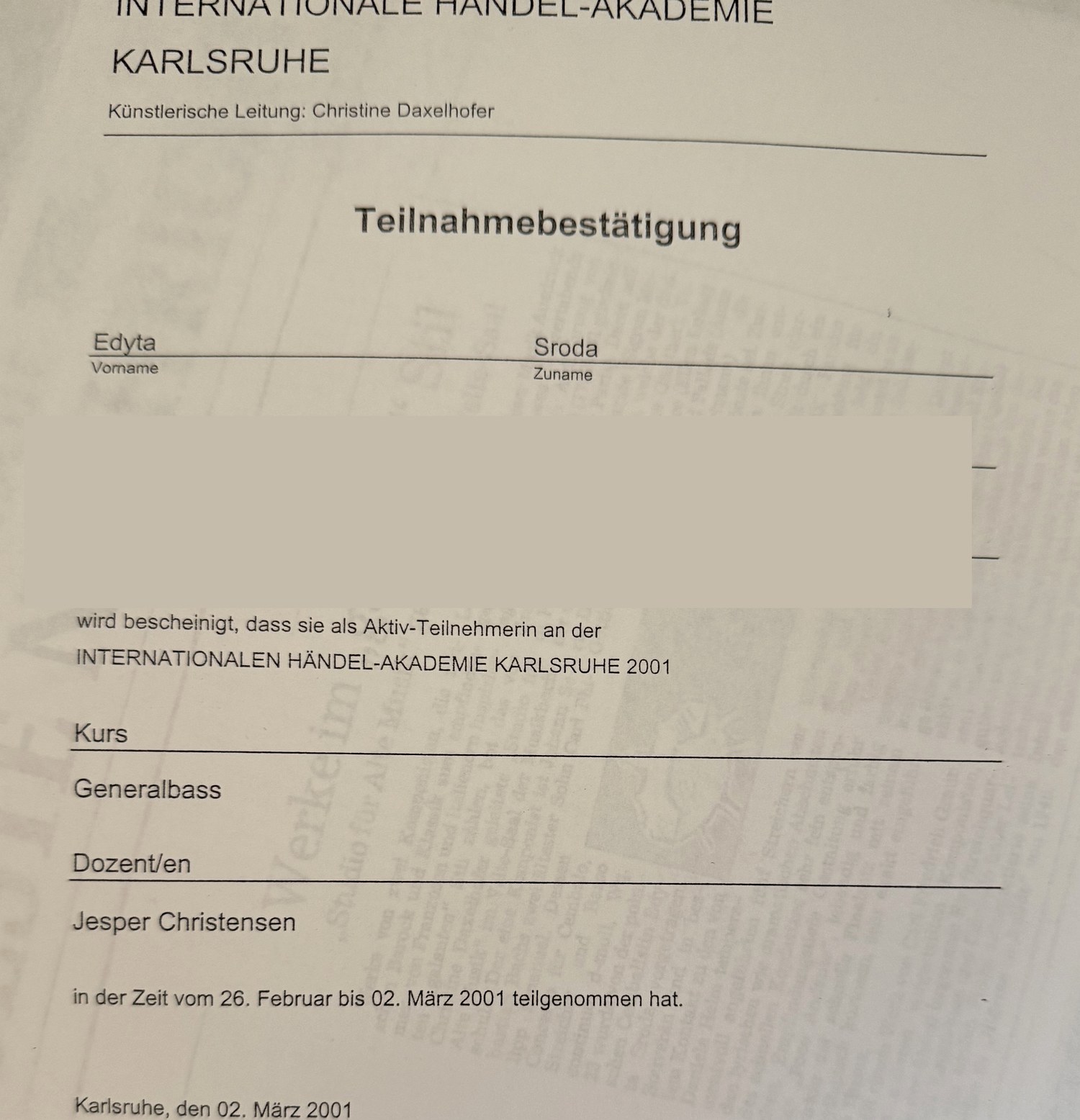
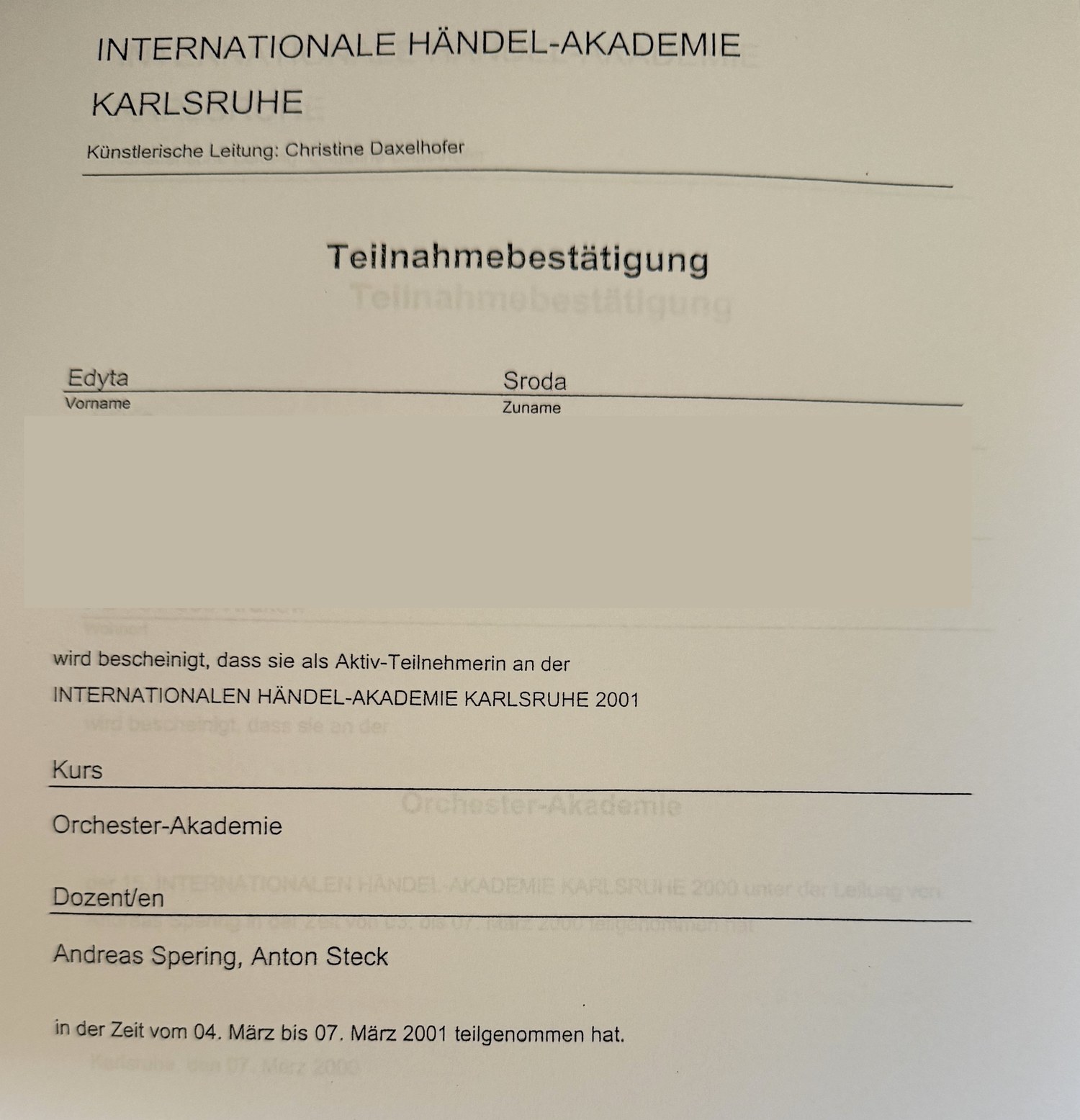
A figured bass course with Jesper Christensen from 26 February to 2 March, followed by work in the Orchester-Akademie with Andreas Spering and Anton Steck from 4 to 7 March. Basso continuo demanded harmonic knowledge, ensemble awareness and an immediate response at the same time.
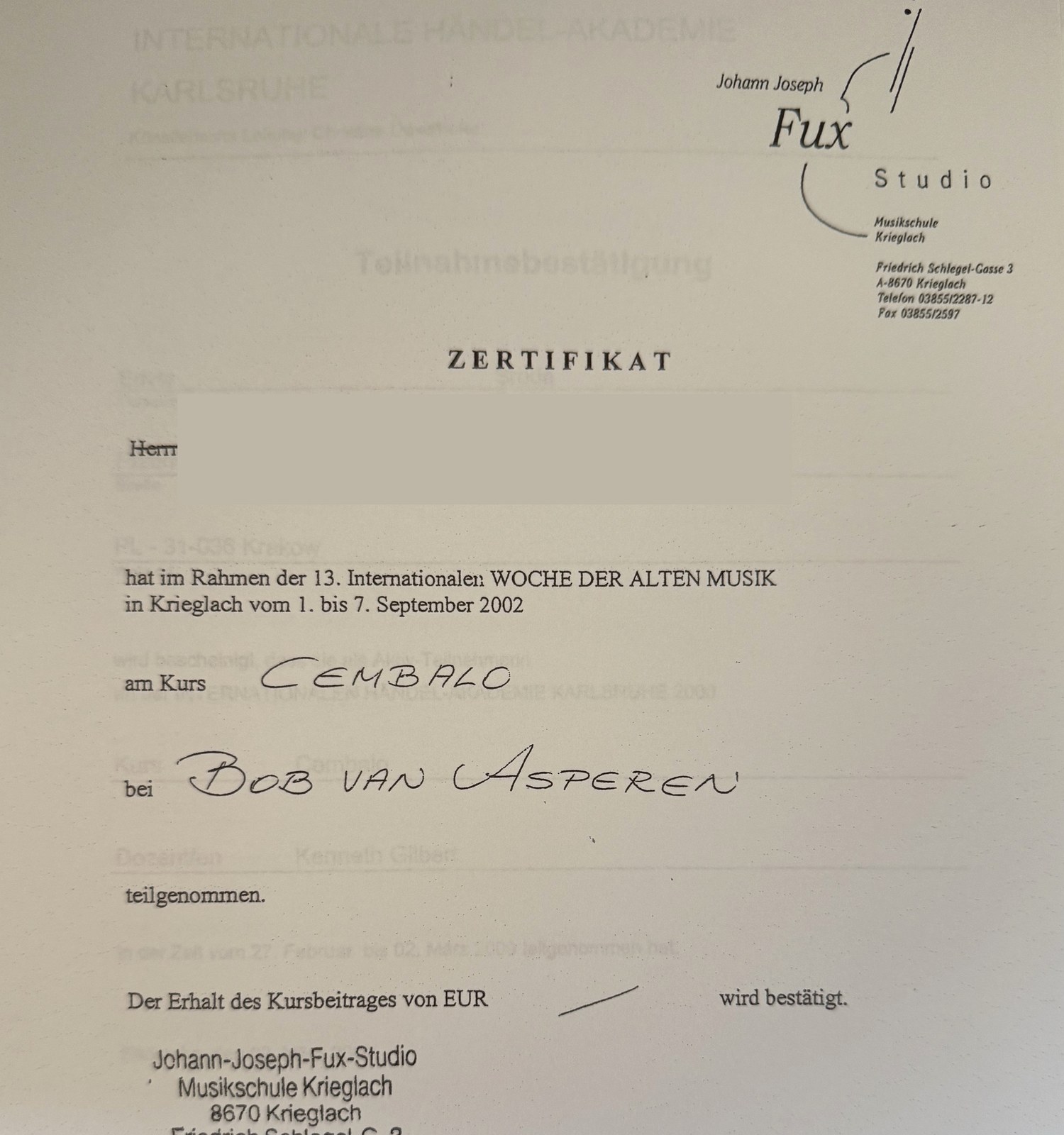
Participation in the XIII Internationale Woche der Alten Musik in Krieglach, from 1 to 7 September. The material documents further work on harpsichord repertoire with one of the important representatives of historical keyboard performance.
2003
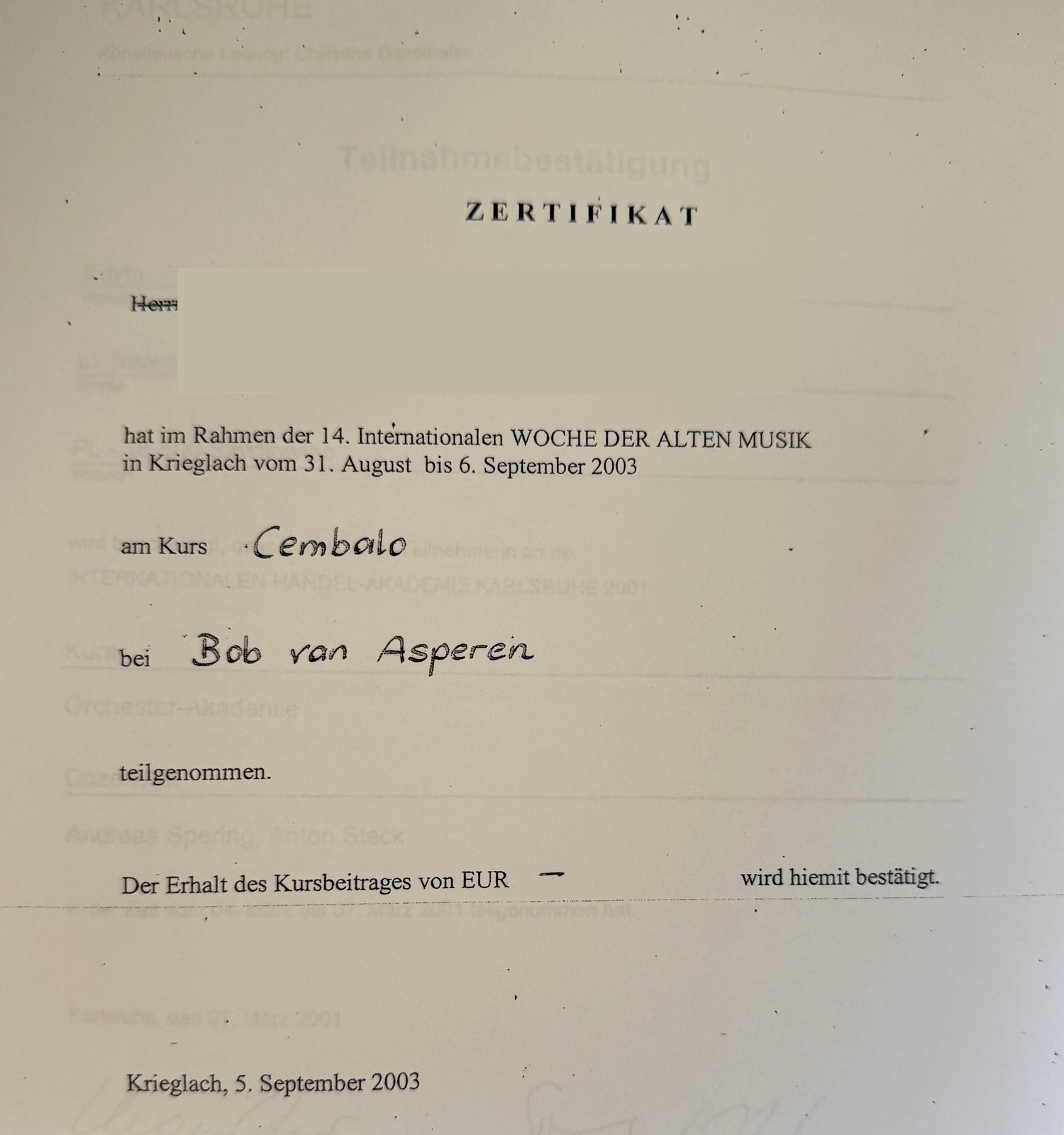
Further work with Bob van Asperen
A second surviving certificate, from the XIV Internationale Woche der Alten Musik in Krieglach, confirms the continuity of her course work from 31 August to 6 September.
Write which instrument you play, what you are working on and what you expect from the consultation.
02
Material before the session
If it would be helpful, you can send the title of the work, an excerpt from the score or a short working recording. We will agree the scope individually.
03
Online session
An hour of one-to-one work: performance, conversation, trials of different solutions, correction and the identification of priorities.
04
Independent further work
After the consultation, you know what to focus on, how to practise and how to assess your own progress.
Essential information
Questions before the first session
Are these conventional instrument lessons?
No. Tutoring is intended for people who already play and come with a specific aim, repertoire or performance problem. It is not an offer of basic instrumental tuition for young children.
Do I need to be a professional musician?
No, but previous instrumental experience is necessary. A student, working organist, graduate, musician returning to playing or advanced amateur can benefit from a consultation.
Can I prepare for an examination?
Yes. A session can cover an examination programme, a trial performance, interpretation, a preparation plan, work on concentration and the building of confidence on stage.
Can we work from a recording?
Yes. A short recording sent before the session may help with the assessment. It does not, however, replace working together live, when the proposed solutions can be tested immediately.
How long is a consultation and how much does it cost?
An individual online session lasts 60 minutes and the price starts at EUR 60. Any series of further consultations is agreed only when it genuinely serves the musician’s aim.
Which languages can be used?
The session can take place in Polish or German. It is worth stating your preferred language in your first message.
Online artistic tutoring
Bring a work, a question or a problem. Together we will look for the way forward.
60 minutes · from EUR 60
An individual consultation for musicians and students: piano, harpsichord, organ, interpretation, examination preparation and stage development.